The key question isn’t which lift reaches the greatest height. It’s whether the crew needs to work directly above the machine or needs to reach up and out around something in the way. That distinction drives the scissor lift vs. boom lift decision more than any maximum height number on a spec sheet.
A scissor lift is a mobile elevating work platform (MEWP) that raises its platform straight up. A boom lift uses an extendable arm to position workers away from the machine as well as above it. Before reserving equipment, we help customers compare the actual work position, site access, surface conditions, load requirements, and rental period.
For projects in Los Angeles, a machine that fits the work can still be impractical if it can’t pass through a gate, turn into a congested work area, or sit safely on the available surface. We offer daily, weekly, and monthly rental terms so the equipment choice can fit the scope of the project rather than a one-size-fits-all schedule.
The Main Difference: Scissor Lift vs. Boom Lift
A scissor lift is designed for vertical access. A boom lift provides vertical access plus horizontal outreach. If the work area is directly overhead and there’s enough clear, level space to position the machine, a scissor lift is often the more practical choice. If the crew must reach past a roof edge, tree canopy, machinery, utility feature, or architectural detail, a boom lift is likely necessary.
Working height is the elevation a worker can reach from the platform, not simply the platform floor height. Horizontal outreach is the distance a boom can extend outward from its base. These measurements, along with platform capacity, obstacle clearance, turning space, and ground conditions, should guide the selection.
Published specs are model dependent. One lift can have a meaningfully different platform capacity, stowed width, gradeability, or outreach than another machine in the same general category. The selected unit needs to match the job, not just the category label.
When a Scissor Lift Is the Better Fit
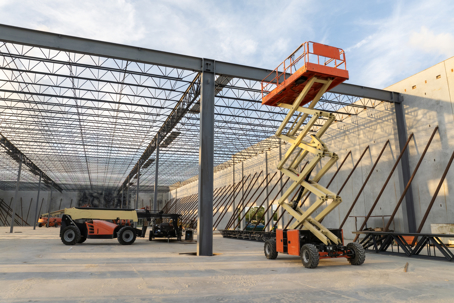
Choose a scissor lift when workers need a broad work area directly above a stable setup location. These machines are commonly used for interior maintenance, warehouse work, ceiling installation, painting, lighting, and repetitive tasks along a wall or overhead plane. The platform can give a crew room for tools and materials, subject to the capacity rating of the selected model.
An electric scissor lift is a strong fit for indoor projects with smooth, firm floors and limited ventilation. Its compact footprint helps in facilities where door widths, aisle space, floor loading, and overhead obstructions affect access. Measure the full route from the entrance to the work zone, including turns and door openings, before scheduling delivery or pickup.
Some scissor lifts are built for outdoor use on suitable surfaces. A rough terrain model generally handles uneven jobsite conditions, but that doesn’t mean every slope, soft area, trench edge, or loose gravel surface is appropriate. The operating manual and machine rating matter, as do recent weather and any changes to the site.
When a Boom Lift Is the Better Fit
A boom lift is the stronger choice when positioning directly under the work is impossible or unsafe. It can place the platform above, beyond, or around obstacles such as roof lines, landscaping, parked equipment, structural features, and building projections. That flexibility is useful for exterior construction, façade work, tree-related access, maintenance, and elevated repairs.
An articulating boom lift has sections that bend at joints, allowing the platform to move up and over an obstruction. This configuration works well where the machine must stay clear of a lower obstacle while the worker reaches an elevated target. It still needs adequate ground space for travel and positioning, plus enough clearance for boom movement.
A telescopic boom lift extends in a straighter line and prioritizes direct reach and height. It may fit a job with a distant, elevated target and a clear path between the machine and the work area. Turning radius, machine dimensions, surface conditions, and required horizontal outreach all need review before equipment is reserved.
Boom lifts typically trade platform space for greater positioning flexibility. Platform capacity can be lower than a comparable scissor lift depending on the model, so crews should account for every worker, tool, and material item planned for the platform.
Compare Jobsite Requirements Before Renting
Access to the work location can determine whether a particular aerial work platform is usable at all. A driveway, side yard, loading area, indoor corridor, parking structure, or active construction zone may limit machine width, transport access, turning room, and delivery placement. Outdoor projects in Los Angeles also require an honest look at the surface under the machine. Concrete, compacted base, pavement, sloped ground, recently watered landscaping, and loose soil each present different operating conditions. Wind exposure near open elevations or building corners can also affect whether elevated work can proceed safely.
Bring these details to the rental conversation:
- Work Height: The approximate height of the task and whether the platform must reach directly overhead.
- Target Position: The horizontal distance from the machine to the work, including any roof edge or obstacle in between.
- Platform Load: The number of workers, tools, materials, and equipment expected on the platform.
- Surface Conditions: The indoor floor type or outdoor terrain where the machine will travel and operate.
- Access Route: Gate widths, door openings, tight turns, overhead restrictions, and space for delivery equipment.
- Project Schedule: The planned rental dates and whether daily, weekly, or monthly terms fit the work sequence.
- Power Needs: Whether an electric machine or another power configuration better suits the work environment.
Fall protection, the equipment and procedures used to reduce the risk of a fall from elevation, also belongs in the planning conversation. Requirements can depend on the lift, the work activity, manufacturer instructions, and site rules. Operators should review the selected machine’s operating guidance before use.
Scissor Lift or Boom Lift: Which One Should You Rent?
Rent a scissor lift if the work is directly above a stable setup area and the crew benefits from a larger platform. Consider a boom lift if the task requires outreach or the platform must clear an obstacle. If either machine could reach the target, compare platform space, positioning flexibility, terrain capability, access route, and anticipated rental duration.
Start the decision with where the worker must stand to complete the task, not the highest number advertised for a machine. A lift with more reach than needed creates access and positioning problems. A lift with insufficient outreach leaves the crew unable to reach the work safely.
We serve contractors and customers throughout Los Angeles County and Ventura County and can help match equipment to your specific work area. Calgrove Equipment Rentals offers modern, maintained equipment, two locations, and delivery and pickup throughout Los Angeles County. Reach us at (818) 805-1617 to discuss your aerial lift rental.